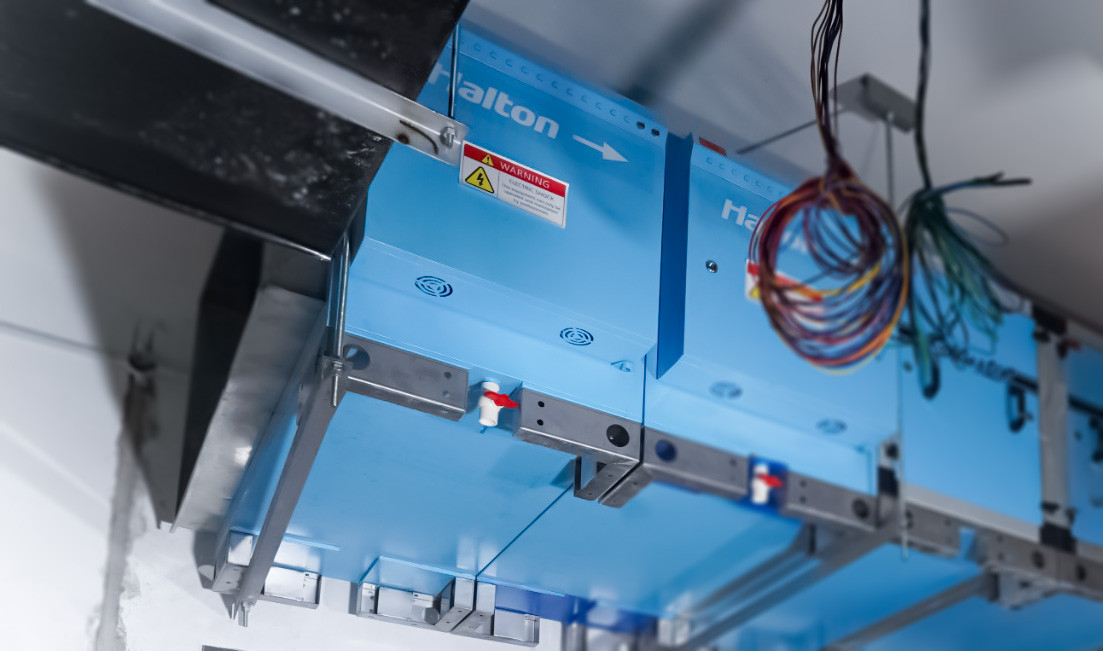

“Grease” is often used as a catch-all term in commercial kitchen ventilation projects, but it can refer to very different problems. In some cases, the concern is visible grease mist and smoke particles in the exhaust air. In others, the concern is the impact of kitchen exhaust emissions on neighbouring properties.
These issues require different approaches and should not be treated as a single air-treatment challenge. Installed downstream in the kitchen exhaust system, Halton Electrostatic Precipitator (ESP) units capture airborne particles that remain after cooking effluent has entered the kitchen exhaust system. Identifying the pollutant is therefore the first step towards selecting the right configuration.

Not Every “Grease Problem” Is the Same
When someone says that a kitchen has “too much grease,” they may be describing one of two issues. High-temperature cooking methods, such as stir-frying and deep-frying, can generate high concentrations of airborne grease and smoke particles. In other cases, the concern is whether the discharge affects the surrounding area.
The two issues call for different approaches. Assuming that one device will address both can lead to the wrong system specification.
ESP Removes Grease and Smoke Particles
The principle behind electrostatic precipitation is straightforward. As exhaust air passes through the unit, grease and smoke particles are electrically charged, attracted to stainless steel collection plates and removed from the airstream.
An ESP is primarily designed to remove grease mist, smoke and other airborne particles. As a downstream treatment device, it does not capture cooking effluent escaping from the cooking area—that is the hood’s role. Nor does it remove grease already deposited in upstream ductwork, which must be addressed through regular duct cleaning.
ESP and Odour Control
An ESP is primarily designed to remove airborne particles, so its effect on gaseous odours may be limited. Where additional odour control is needed, technologies such as UV treatment or activated carbon may be considered.
Halton ESP units can also be supplied with a UV module. In this configuration, the ESP captures grease particles while the UV module provides additional treatment for odours in the exhaust air.
Define the Objective Before Selecting the System
Start by identifying both the pollutant and the required discharge outcome. What pollutants need to be addressed, and what discharge requirements must the system meet?
Once the objective is clear, the project team can determine the role of the ESP and whether additional treatment stages are required. Actual removal performance should be assessed using test data for the relevant product and configuration, rather than applying a single performance claim to every project.
Maintenance and Cleaning
Halton ESP uses reusable stainless steel collection plates, reducing the need for disposable filter replacements. Regular cleaning is still required to maintain performance.
By reducing the amount of grease entering downstream ductwork, Halton ESP can slow the build up of grease deposits and may allow longer intervals between cleanings. Even so, ductwork should still be inspected regularly, with cleaning schedules based on operating conditions and applicable requirements.
Conclusion
An ESP primarily removes grease mist, smoke and other airborne particles from kitchen exhaust air. Where additional odour control is needed, Halton ESP units can be configured with a UV module.
System selection should start with the pollutants to be addressed and the discharge requirements to be met. These define the role of the ESP and any additional treatment stages.
Halton ESP can also be integrated into a broader kitchen exhaust filtration system. Explore Halton PST to learn more.