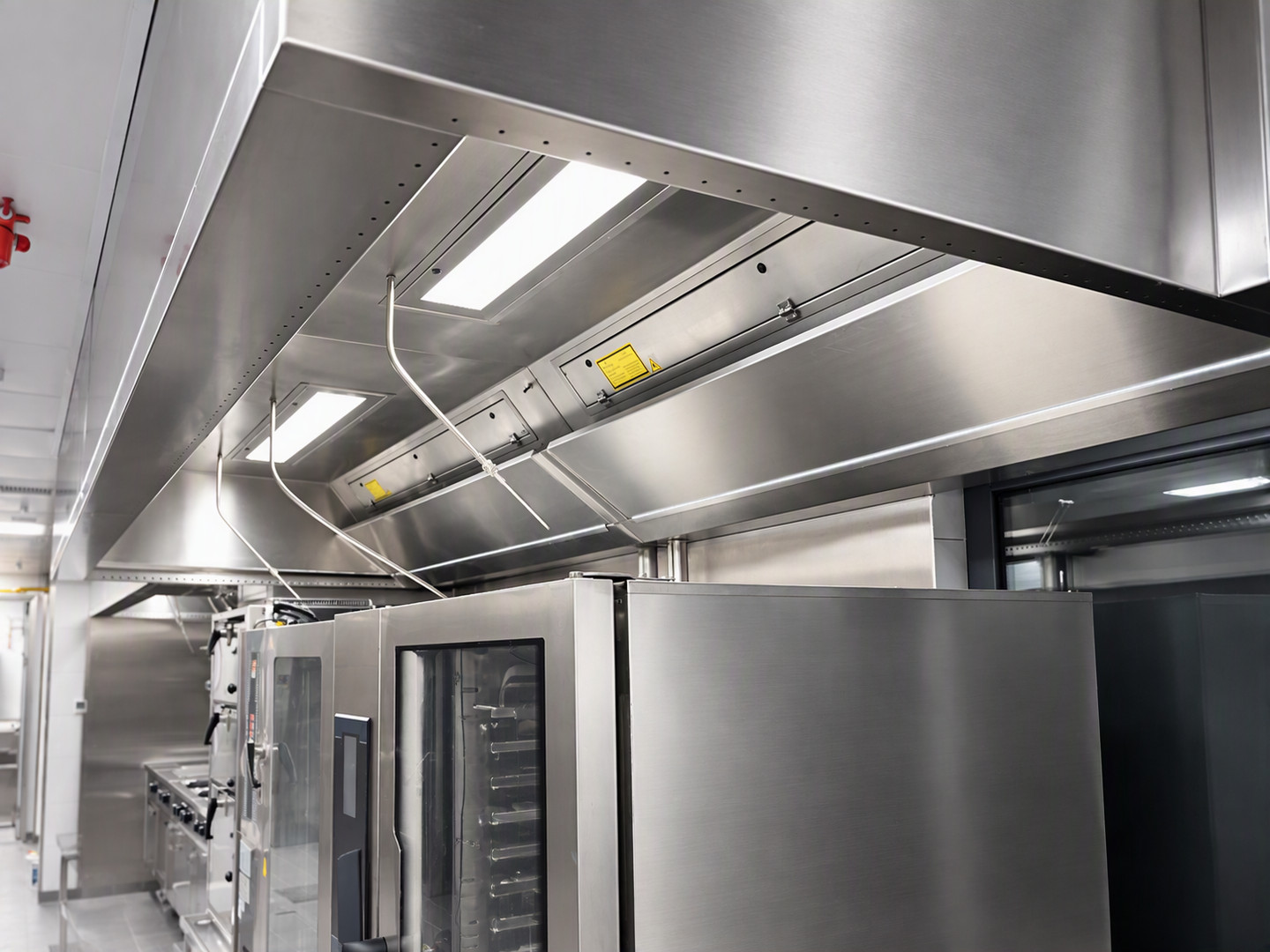
Open kitchens are increasingly common in modern dining, combining transparency with a more engaging customer experience. In practice, this often means managing multiple cooking conditions within the same space.
In a recent project in Shanghai, an open kitchen integrating high-temperature charcoal cooking alongside other processes created a demanding environment, where performance, hygiene, and fire safety had to be addressed simultaneously.

The Challenge of Diverse Cooking Conditions
Unlike enclosed kitchens, open kitchen environments must prevent heat, smoke, and grease from impacting the dining area while maintaining stable performance during peak operations.
This challenge is amplified when multiple cooking methods are combined. Charcoal cooking, in particular, introduces one of the highest risk profiles due to:
- Extremely high temperatures over 1000℃
- Continuous grease and particle emissions
- The presence of sparks from open flames
As a result, ventilation design becomes a risk-based challenge, requiring different control strategies across the kitchen.

Designed for Different Cooking Zones
To address the complexity of an open kitchen with diverse cooking equipment, the ventilation system is designed to respond to different cooking conditions, rather than applying a single solution.
Charcoal cooking zones, where high temperatures and sparks are present, are equipped with Halton exhaust hood(CMW-FMOD) integrating Cold Mist and Water-wash technology. Halton Cold Mist helps manage these conditions by releasing a fine water mist when sparks enter the hood area. This helps:
- Cool down hot particles
- Limit the upward movement of sparks
- Reduce the chance of sparks entering the exhaust duct
Halton Water-wash periodically cleans the interior of the hood, helping to reduce dust and grease build-up at source.
In parallel, other cooking areas with significant grease emissions are fitted with Halton UV Capture RayTM hood(UWF). Halton Capture RayTM technology supports grease reduction by breaking down grease particles before they accumulate within the ductwork.
This approach ensures that smoke, grease, and potential fire risks are managed effectively across the kitchen.
Performance in an Open Kitchen
The combination of capture efficiency, grease control, and fire risk mitigation enables:
- Effective containment of heat and smoke
- Improved working conditions in the kitchen
- Minimal impact on the dining environment
- Stable performance during peak hours
This balance is essential in open kitchens, where operational performance directly affects the customer experience.
Project Note
The approach described in this article is based on a real project delivered for Pintxos, a Spanish restaurant located in ITC Mall, Shanghai.