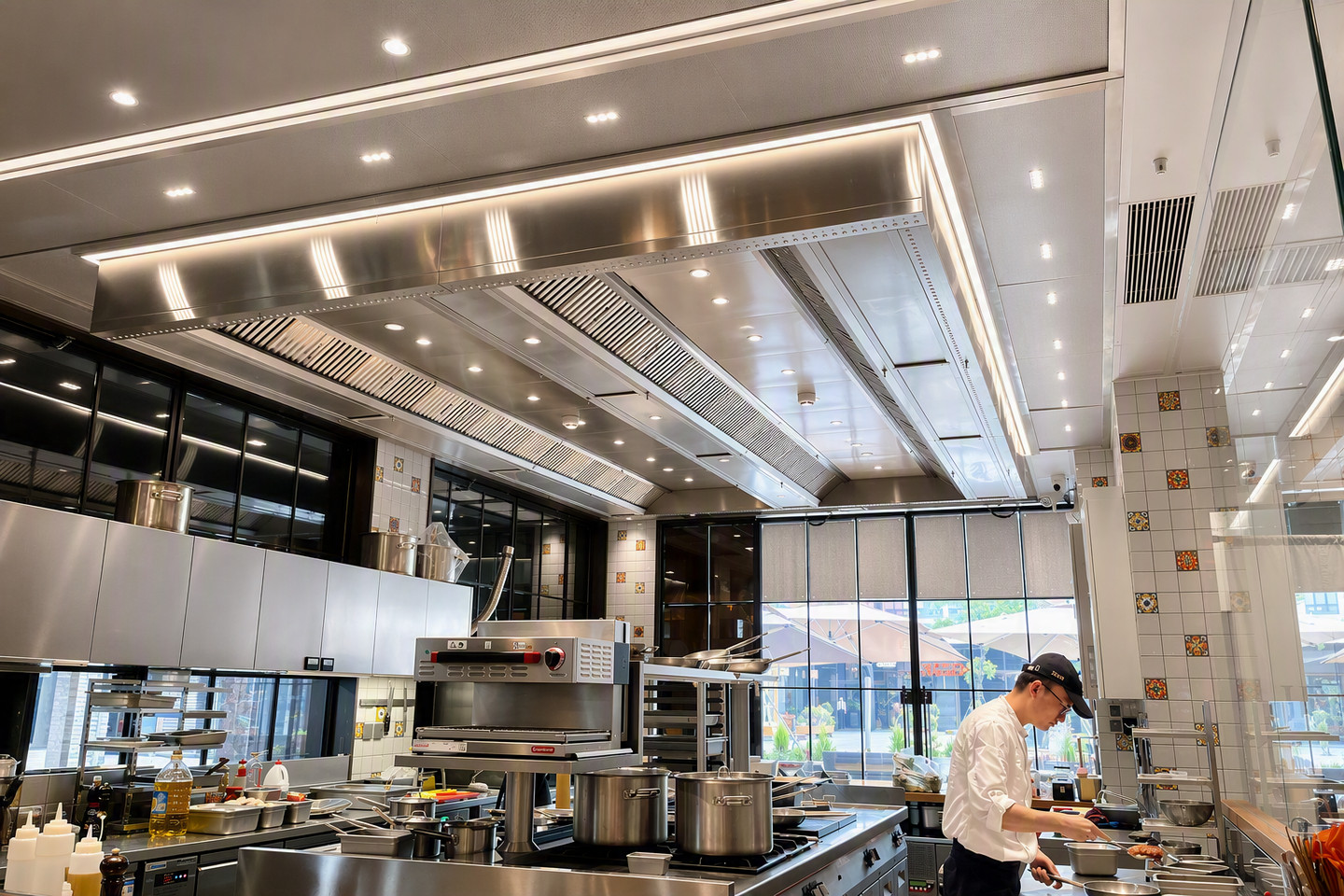
Open galleys are increasingly common on modern cruise ships, where cooking activities take place in close proximity to guest dining areas. While this enhances the dining experience, it also makes stable environmental control more difficult to achieve. Large cruise ships typically operate multiple galleys serving different dining venues.
As a result, ventilation systems must not only manage grease, heat and cooking effluents, but also maintain a stable environment throughout changing operating conditions.

Open Galleys Directly Affect Guest Dining Areas
In an open galley, cooking activities are much closer to guests.
If grease, steam, odours, heat or other cooking effluents are not effectively controlled, they can affect adjacent dining areas. Therefore, the objective of galley ventilation is not simply to remove contaminants, but to capture and control them as close to the source as possible. This is also the principle behind modern galley ventilation and display cooking solutions.
Multiple Galleys Create Constantly Changing Conditions
Large cruise ships often include several galleys serving different dining venues and cooking operations. As cooking activity, heat loads and grease emissions vary throughout the day, ventilation systems must maintain stable environmental control across continuously changing operating conditions.
Stable Environmental Control Depends on Airflow Management
According to ISO 9943 requirements related to ship galley ventilation, galleys are generally maintained at a lower pressure than adjacent occupied spaces to reduce the migration of cooking effluents and steam.
This helps maintain a stable environmental boundary between the galley and guest dining areas, even as cooking activity and operating conditions change.
Marine Conditions Add Complexity
Galley ventilation systems must operate reliably in high-humidity, saly ocean environments while also withstanding continuous vibration, vessel motion and limited installation space. These factors influence equipment durability, maintenance requirements and long-term performance.
Conclusion
Successful galley ventilation design is not simply about providing more airflow. It is about maintaining consistent control of grease, heat and cooking effluents while preserving comfort in dining areas throughout the vessel’s operational life.
Halton provides galley ventilation solutions for cruise ships and ferries, including galley hoods designed for open galley and display cooking applications. These solutions help maintain stable environmental control by managing grease, heat and cooking effluents close to the source, with designs that can be adapted to applicable USPHS requirements for hygiene, cleanability and food safety.
Click here to learn more about Halton’s ventilation solutions for cruise ships and ferries.