

Product / REC
NEW! Halton CaBeam REC – For Passenger and Crew Cabins
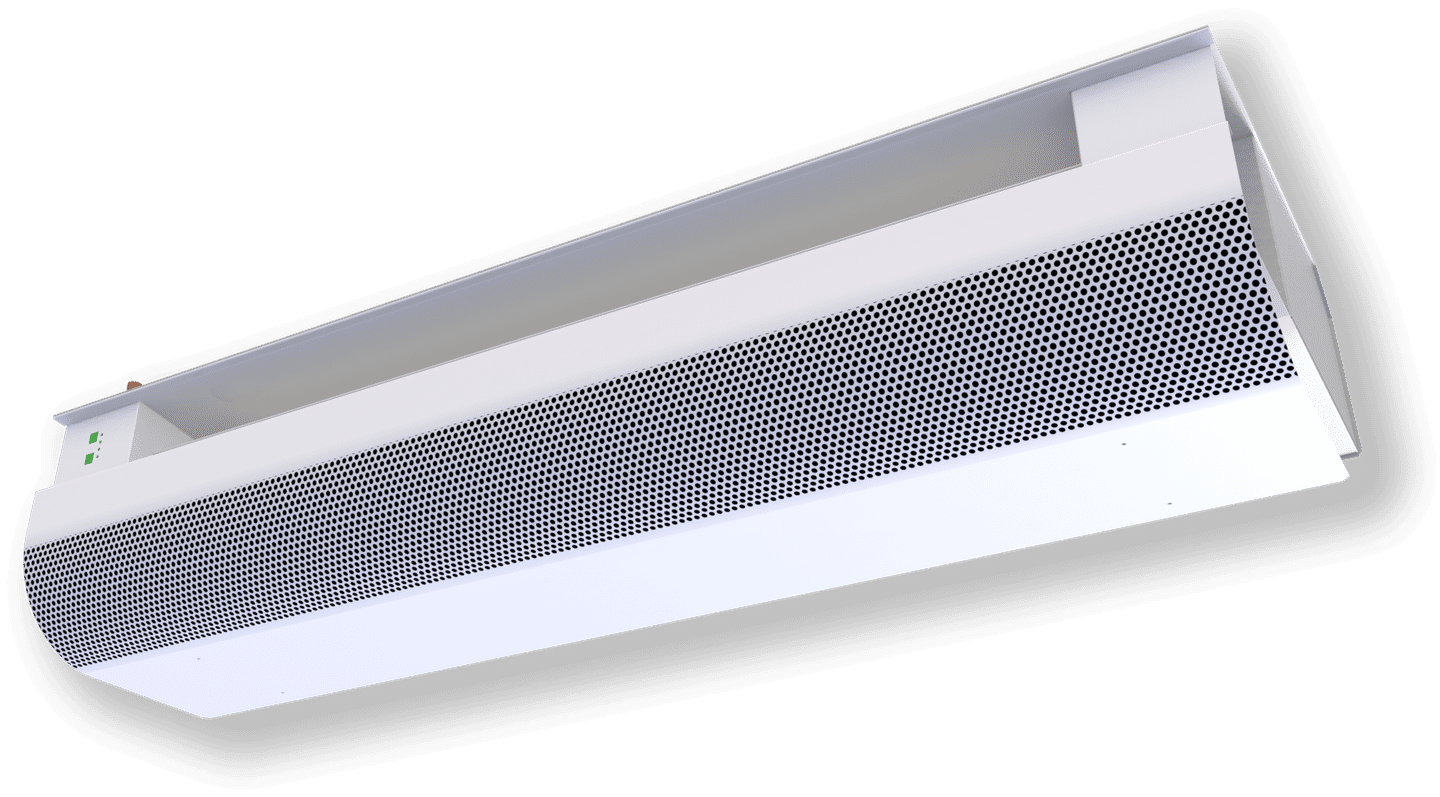
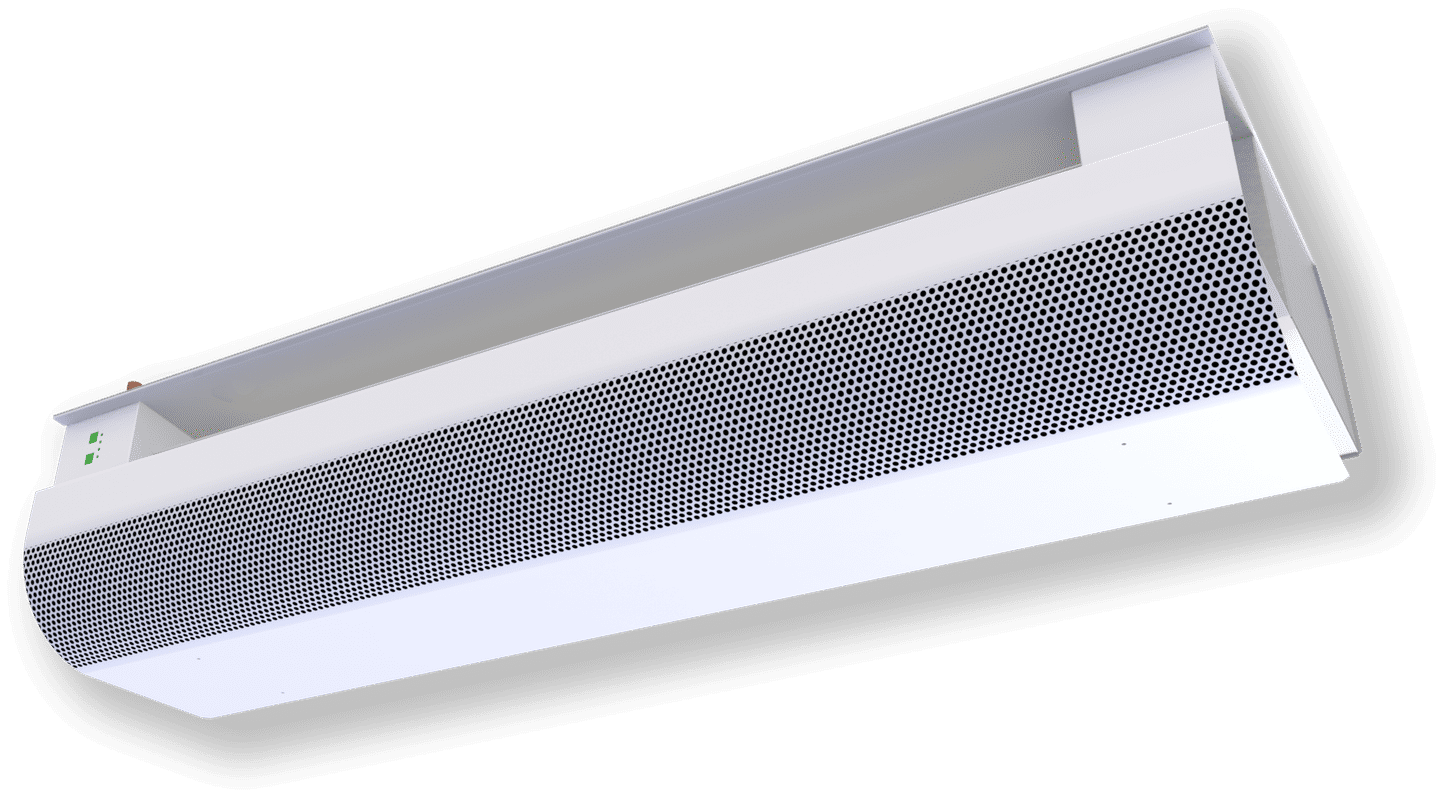
Halton CaBeam is a cooling, heating, and ventilation solution specifically designed to provide the best indoor comfort for demanding marine applications such as cabins on cruise ships and passenger ferries or living quarters on offshore substations.
Specification
The Halton CaBeam units have been specifically designed for silent cabin comfort with sophisticated air treatment and control. The Halton CaBeam is available as an exposed, recessed or integrated installation. The new version Halton CaBeam REC differentiates from traditional chilled beams by more efficient cooling from compact unit with integrated functions.
The exposed CaBeam unit is an active chilled beam solution for demanding marine applications. The active chilled beam system employs fins to help heat and cool. The system is effective to the point where outdoor air can be mixed with the indoor air without any traditional air conditioning (such as heating, cooling, humidifying, or dehumidifying), allowing the building/ship to meet its “minimum outdoor air” air quality requirements.
The active chilled beam system requires much less energy to achieve the same heating and cooling effect as a traditional HVAC system.
The beam acts as a convector chilled by recirculated water. The warm air rises and is cooled by the chilled beam; once it is cooled, the air falls back to the floor, where the cycle starts over. The ventilation air is delivered to the beam by a central air-handling system via ductwork.
Overview
- The active chilled beam has an integral recirculation air path through the perforated front panel
- The front panel is openable from either side to allow general maintenance and cleaning
- The front panel is removable without any special tools
- The inlet duct connection is modifiable and can be located at the right, left, or middle of the supply-air plenum.
- The heat exchanger of the beam is oriented such that the water connections can be on either the right or left side of the beam
- All pipes are manufactured from copper, connection pipes with a wall thickness of 0.9–1.0 mm fulfilling the European Standard EN 1057:1996. The fins of the heat exchanger are manufactured from aluminium or copper as an option. The heat exchanger is factory pressure-tested. The maximum operating pressure of chilled/hot water pipework is 1.0 MPa
- The supply air ductwork connection is D125 mm
Tailoring
The Halton CaBeam units can be tailored to customer demands according to the needed integration and requirements. Dimensions, capacities, and functionality details can be modified to project-specific. An advanced digital room temperature control completes the solution.
Materials
| PART | MATERIAL | FINISHING |
| Front panel | Pre-painted galvanised steel |
Polyester-epoxy-painted White RAL 9003 20% gloss* |
| Supply air plenum | Galvanised steel | |
| Brackets | Galvanised steel | |
| Coil pipes | Copper | |
| Coil fins | Aluminium | Copper as an option |
*) Special colours available
Features
- The active chilled beam has an integral recirculation air path through the perforated front panel
- The front panel is openable from either side to allow general maintenance and cleaning
- The front panel is removable without any special tools
- The inlet duct connection is modifiable and can be located at the right, left, or middle of the supply-air plenum.
- The heat exchanger of the beam is oriented such that the water connections can be on either the right or left side of the beam
- All pipes are manufactured from copper, connection pipes with a wall thickness of 0.9–1.0 mm fulfilling the European Standard EN 1057:1996. The fins of the heat exchanger are manufactured from aluminium or copper as an option. The heat exchanger is factory pressure-tested. The maximum operating pressure of chilled/hot water pipework is 1.0 MPa
- The supply air ductwork connection is D125 mm
Function
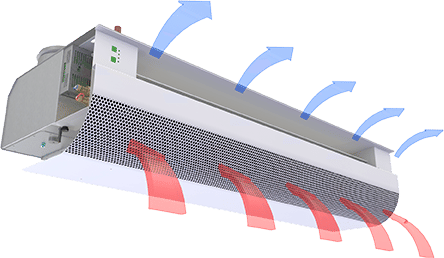
The supply air enters the plenum of the active chilled beam, from which it is diffused into the room through nozzles and the supply slot located on the top of the beam.
The supply air nozzle jets efficiently induce ambient room air, which is then directed horizontally along the ceiling surface. The secondary air is drawn through the perforation located at the bottom of the beam. The air is then cycled through the heat exchanger, where it is either cooled or heated before being diffused into the room.
The cooling capacities of the active chilled beam are controlled by regulating the water flow rate according to the control signal of the room temperature controller.
Installation
Easy installation can be ensured in a prefabricated cabin. The manufacturing method and innovative, compact design allow units to be modified for any situation.
Design Criteria
- Room design temperature 22°C / 50% RH
- Fresh air rate 50-200 m3/h
- Nozzle pressure 100-200 Pa
- Sensible cooling power 400-1500 W (depending on coil and water parameters)
- Heating power 300-1200 W
Noise level 25-30 dB(A), boost <35 dB(A) - Chilled water flow 0.02-0.10 dm3/s (360 dm3/h)
- Chilled water inlet temperature 14-16°C
- Chilled water outlet temperature 16-19°C
Note: Halton CaBeam systems are not exchangeable with FCU due to differences in the cooling circuit. Halton CaBeam systems take care of air distribution in the cabin as well.
Dimensions and Weight
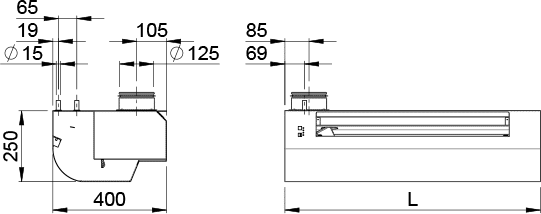
| Coil length | 600, 900…2100 |
| L-5 | 900, 1200…2400 |
| kg | 900 mm long chilled beam is 21,5 kg (with cooling water +0,5 kg) |
| 1200 mm long chilled beam is 26,5 kg (with cooling water +0,8 kg) |
Adjustments
Cooling
The recommended cooling water mass flow rate is 0.03-0.10 kg/s, resulting in a temperature rise of 1-3°C in the heat exchanger. To avoid condensation, the recommended inlet water temperature of the heat exchanger is over 14°C.
Heating
The heating of the cabin is done by an integrated electric heater in the CaBeam or by electric heater in the inlet water pipe. The electric heater is equipped with capillary thermostat with a safety switch with state detection and manual reset in close proximity of heater. Heater control is automated by integrated control system and includes detection of air movement and safety relays for extended safety.
Heating with Water (Option)
The recommended heating water mass flow rate is 0.01-0.04 kg/s, resulting in a temperature drop of 5-15°C in the heat exchanger. The maximum recommended temperature of the inlet water for the heat exchanger is 35°C…45°C.
Balancing and Control of Water Flow Rates
Balance the water flow rates of the chilled beam with adjustment valves installed on the outlet side of the cooling and heating water loops. The cooling capacity and heating capacity of the chilled beam are controlled by regulating the water mass flow rate. The water mass flow rate can be controlled by using an ON/OFF valve or a two- or three-way proportional valve. Valves can be integrated to the CaBeam.
Adjustment of Supply Airflow Rate
Connect a manometer in the measurement tap and measure the static pressure in the chilled beam. The airflow rate is calculated according to the formula below.
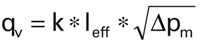
Ieff = length of the coil (m)
∆pm = measured static chamber pressure (Pa)
| NOZZLE | k (l/s) | k (m3/h) |
| C | 1,36 | 4,90 |
| D | 2,09 | 7,52 |
| E | 3,33 | 11,99 |
Condensation Prevention
Air relative humidity and temperature will rise radically when the balcony door/window is opened. Relative humidity of air might also rise when the shower is on long periods and the toilet locker door is open.
This could cause condensation on the surface of the beam coil. Halton CaBeam can be equipped with a condensation sensor in cooling water pipe. It closes the cooling water valve automatically if condensation occurs and opens the cooling water valve when there is no condensation risk.
Optionally with electric heater in the inlet water pipe there is possibility to prevent undesired condensation by temperately heating the cooling water flow to raise beam coil surfaces above the dew point.
Together with heating, the cooling valve is driven toward a closed position. Return water temperature is monitored by a sensor and when it reaches the desired level above the dew point the cooling valve is closed completely to prevent unnecessary heating of the cooling water circuit.
Condensation sensor or temperate used heating element can be activated by the balcony door switch. When the balcony door remains open the cooling water circuit remains closed and coil surfaces remain above the dew point. The use of the condensation sensor and humidity sensor has been tested.
Servicing
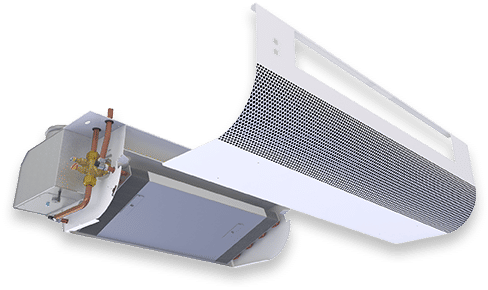
Code Description for Exposed CaBeam
1. Front panel
2. Supply air connection
3. Heat exchanger
4. Female supply air connection
5. Pipe connections
6. Duct cover
Downloads
"*" indicates required fields
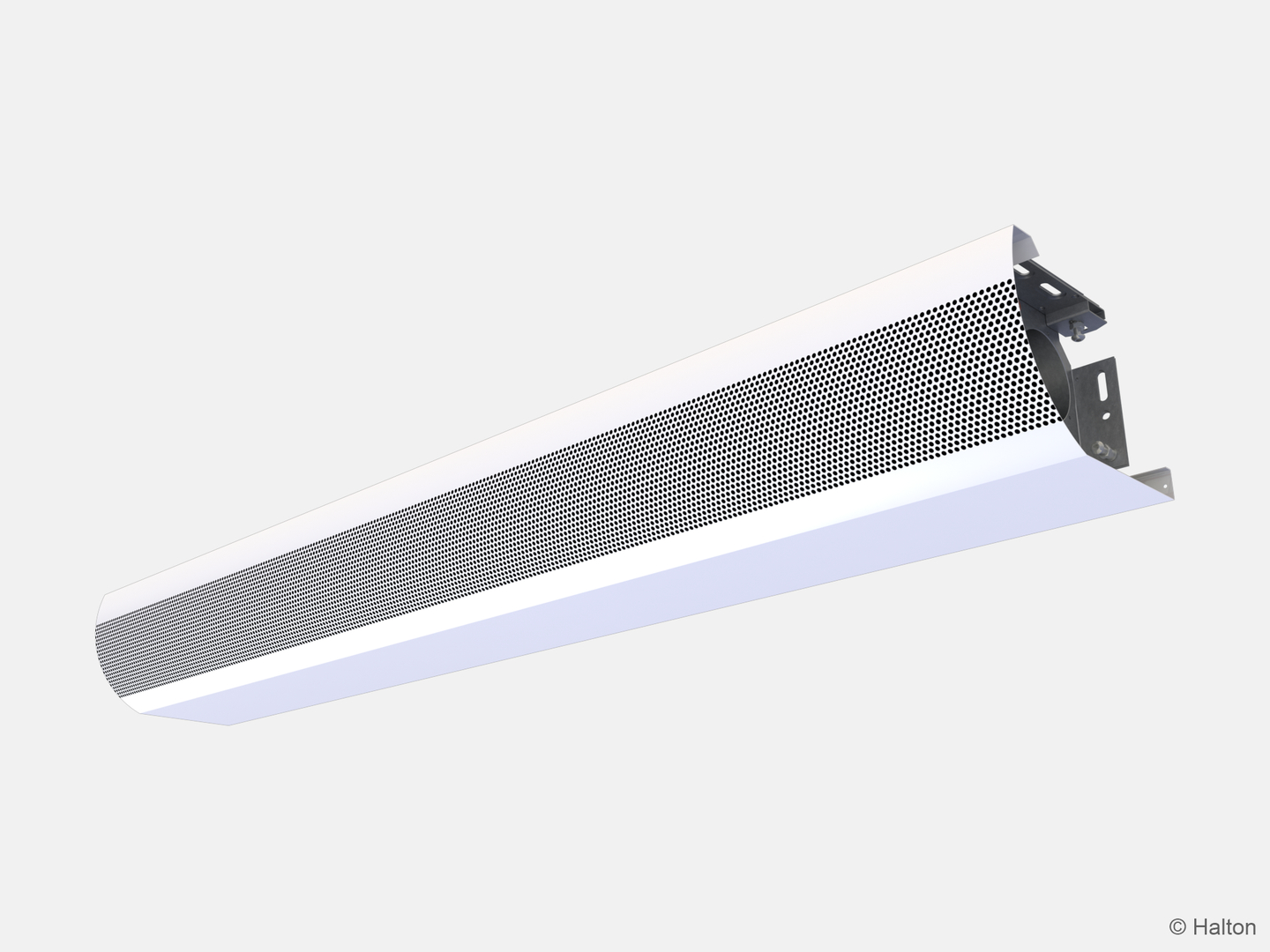
Halton CaBeam – Chilled beam for exposed wall installation
product
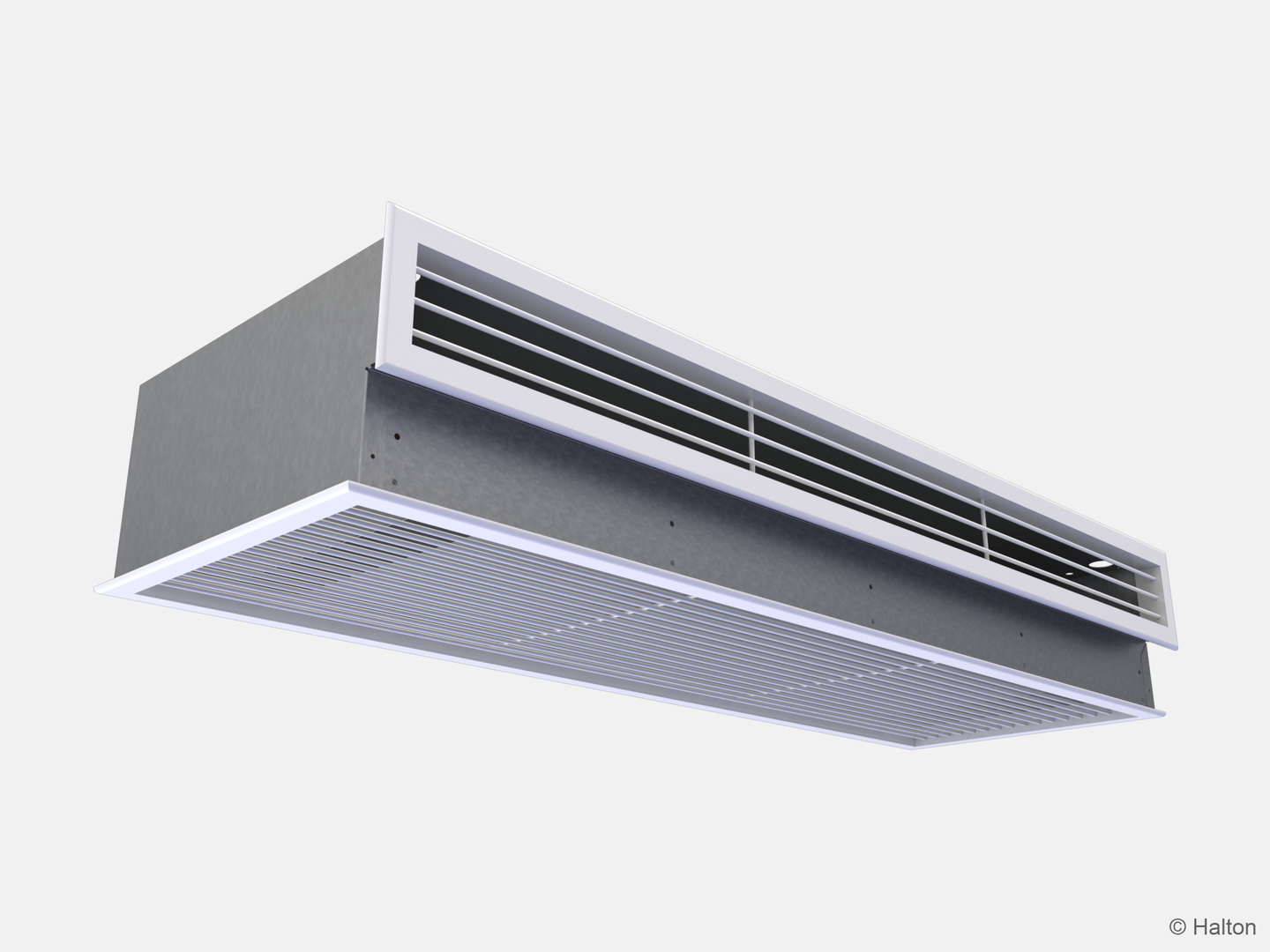
Halton CaBeam – Chilled beam for integrated installation
product
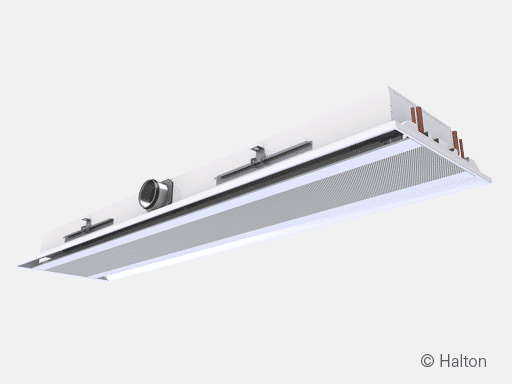
Halton CaBeam – Chilled beam for recessed installation
product
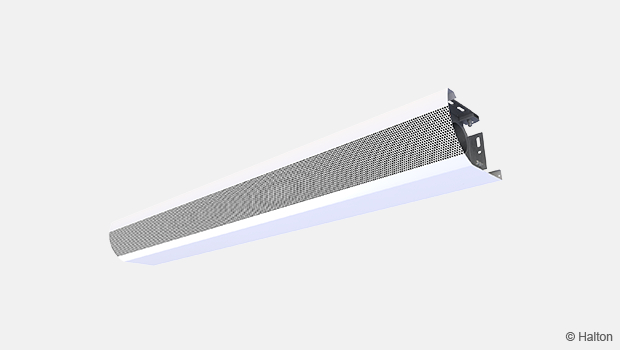
Halton CBH – Chilled beam
product
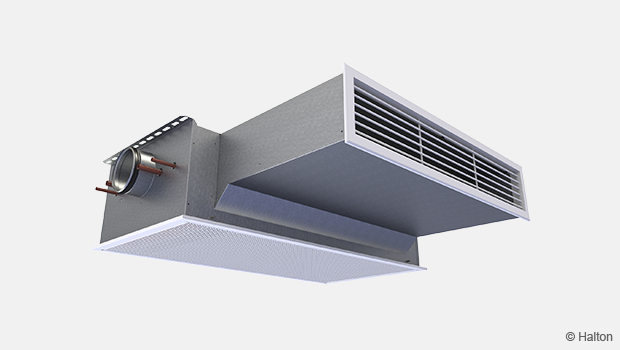
Halton CHB – Chilled beam
product
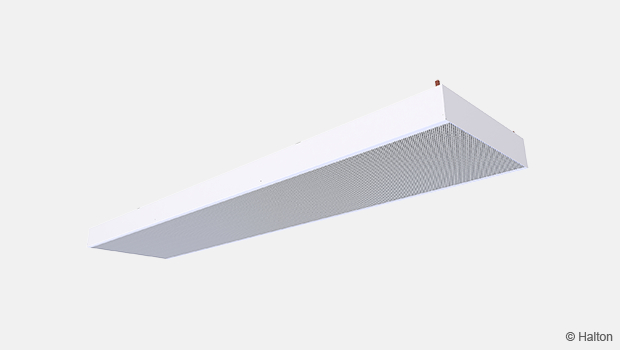
Halton CPA – Passive chilled beam
product
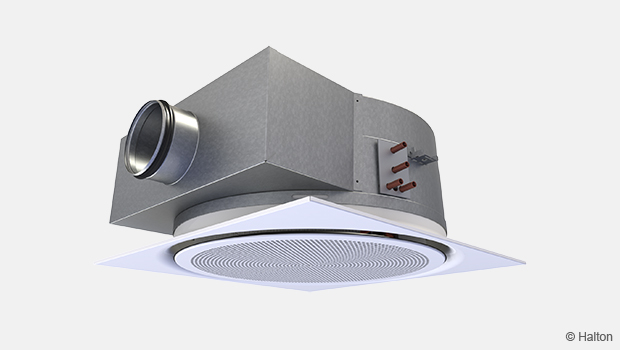
Halton CSW – Swirl comfort unit
product
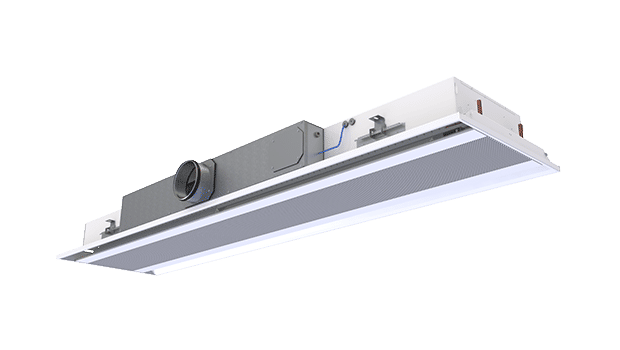
Halton Rex R6W – Variable air volume chilled beam (VAV)
product
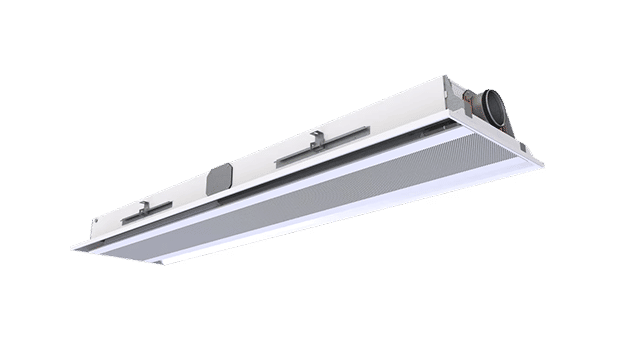
Halton Rex RE6 – Chilled beam
product
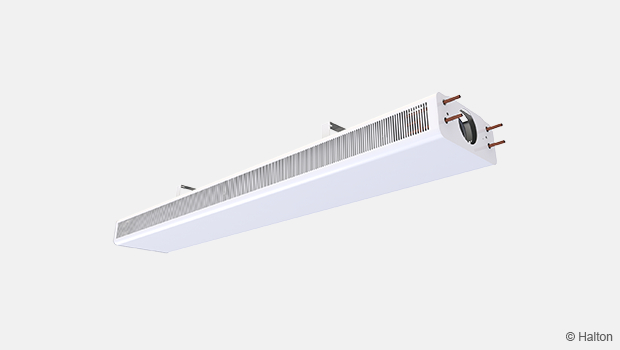
Halton Rex REE – Chilled beam
product
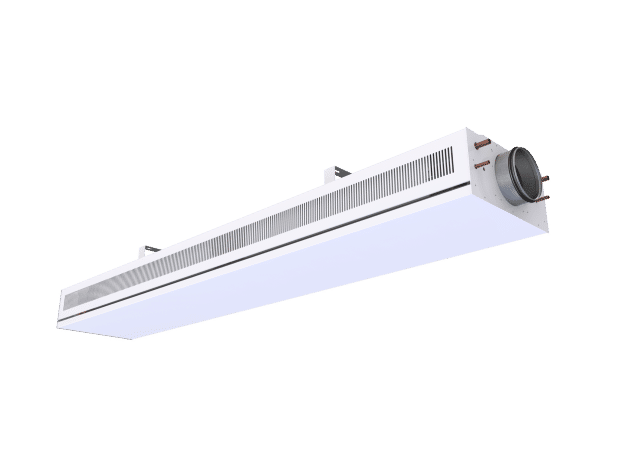
Halton Rex REW – VAV chilled beam
product
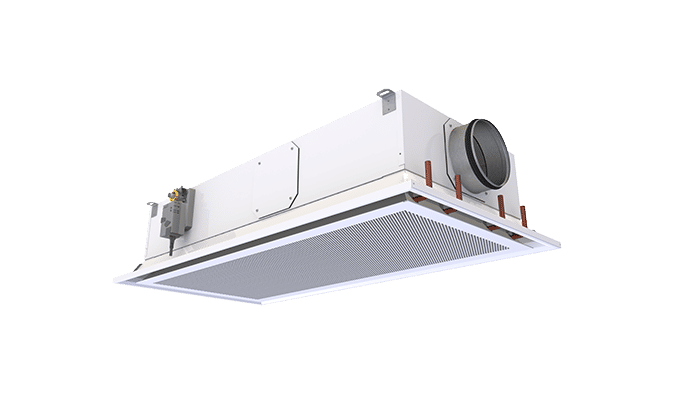
Halton Rex RXP – Chilled beam (CAV/VAV)
product

Halton Vita VPR – Hygienic chilled beam
product
NEW! Halton CaBeam REC – For Passenger and Crew Cabins
product
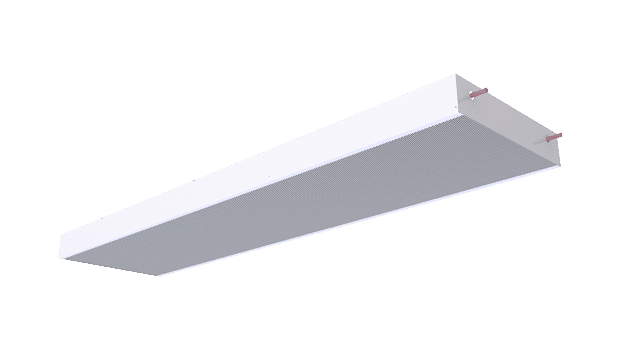
NEW! Halton Rex REP – Passive chilled beam
product
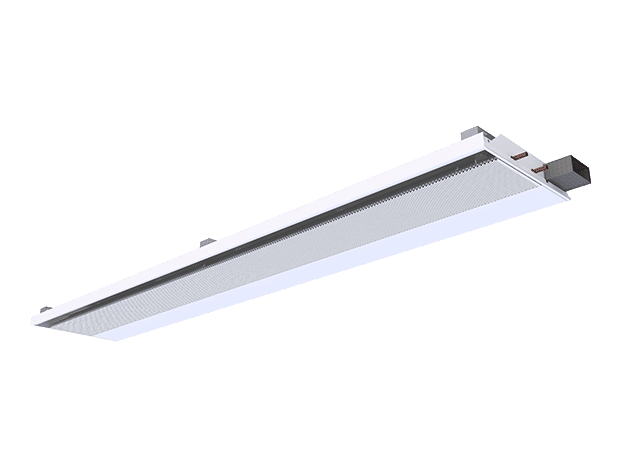
NEW! Halton Rex RSI – Slim induction unit
product